Showing posts with label Charlie Chaplin. Show all posts

Saturday, October 3, 2015

Spring 2015 #15: Modern Times (1936) - Charlie Chaplin

I can feel summer coming, but I still have two films left after this one for some reason! So here were are, back in the Silent Film Era… although not really because the first talkie came out in 1927. How did Charlie adapt?!
Well, apparently, he originally wrote a full script for the film, but abandoned it when he realized that his lovable “tramp” character just didn’t work when he spoke.
Modern Times works both as a slapstick comedy (one of Chaplin’s most revered) and as a biting commentary on the abuse of the working class due to industrialization during The Great Depression.
Here, A Factory Worker’s boss orders him to stop smoking on his break. The boss has cameras watching every worker at all times, and Chaplin’s character just isn’t cut out for that regimented work ethic.
After an awesome scene where he gets sucked into a machine, he begins to have a mental breakdown.
Chaplin ends up getting arrested, where he meets the down-on-her-luck orphan girl with a knack for petty theft.
She even looks fierce stealing a banana. The character, “the Gamin,” is played by famous actress Paulette Goddard. 
Chaplin also goes through a series of mishaps where he is mistaken for a union leader. The film offers a pretty dark depiction on the way the organization of laborers were treated.
But it’s easy to watch the film for what it is, a silly comedy about two lovable misfits falling for each other.
There’s also a great scene where Chaplin’s boss tests out a device that can eliminate the lunch breaks of his workers by mechanically feeding them.
Not sure how he could continue working during this, but okay.
The film culminates in A Factory Worker and A Gamin getting jobs as performing waiters, and Chaplin’s voice is actually heard for the first time ever in a film when he sings a gibberish version of Léo Daniderff’s “Je cherche après Titine.”
Modern Times is all good fun, and it is certainly one of the greatest hits from the king of the Silent Era. The IMDb Top 250 lists it at #39, while the AFI 100 Films puts it at #78. At only 89 minutes, it’s a nice little retreat back to the days of economic despair and abusive factory conditions.

Spring 2015 #2: The French Connection (1971) - William Friedkin

Okay so I don’t know why but Netflix seems to have more Best Picture Winners than IMDb Top 250 films so that’s just how this list is going to go. Which I don’t have a problem with because they’re all on my Watchlist anyway.
image
The French Connection! I feel like I had vaguely heard of this film, but it’s more or less on the list simply because it’s #93 on the AFI Top 100 as well as being on Netflix.
The film follows two detectives, Doyle and Russo, trying to stop a major drug deal between a giant French heroine syndicate and the mob. They have smuggled $32 million of heroine into New York by hiding it in a French television star’s car and have to outsmart the detectives before making the deal.
image
It’s kind of exciting? I don’t know, the plot is kind of predictable: detectives have one tiny lead to go off of, lots of stakeouts, reach a dead end when the villains are overly careful, detectives get thrown off the case for not following the rules, villains slip up, detectives win. Just hearing the title, The French Connection, made me sad that that connection wasn’t Alain Delon.
image
Oh my god I can’t even.
Anyway the inspiration for the film came when William Friedkin was living with Howard Hawks’ daughter, and he asked her if she liked his movies, and she said they were lousy. She said, “Make a good chase. Make one better than anyone’s done.”
And thus one of the coolest chases in film history is born.
image
Doyle avoids an assassination attempt by the French drug dealer’s hitman, who then boards a subway train and literally commandeers the train while Doyle chases it underneath in his car. It’s actually 15 minutes of pure intensity and it was the one time in the film I didn’t look like this.
image
And this is the director who directed The Exorcist two years later! Crazy. I’m sorry, cop movies are not my thing.
The film went on to win Best Picture, Best Director, Best Actor, Best Adapted Screenplay, and Best Editing at the 44th Academy Awards. Fun Fact, this Oscars included a 12 minute long standing ovation for Charlie Chaplin receiving an Honorary Award, the longest applause in Academy history.

Fall 2014 #11: City Lights (1931) - Charlie Chaplin

Two silent films on the same Moviecation list!? I know, crazy, and this isn’t even the last black and white film.
So, the plot is simple. A Tramp (Chaplin) falls in love with a poor blind woman, while simultaneously developing a friendship with an eccentric billionaire. Shenanigans abound.
This is my third Chaplin film, after seeing Gold Rush when I first started my Film Bucketlist (it’s the second film I ever reviewed on this blog!), and then The Kidfor a class. I think Gold Rush kind of set me up for an idea that all of his films are high concept and massive in scope, when really the other two have been just kind of simplistic. Not that that makes them bad, I’m just a millenial with a bad attention span.
From the neck down Chaplin looks like a 13 year old boy here. ANYWAY, this one also includes a long bit where Chaplin needs money to help his love interest, so he thinks he’s going to be boxing in a rigged match, but ends up boxing with someone who has no problem pummeling him.
Also, doing some research (cough Wikipedia), I found that Chaplin started the film at the dawn of the talkies, when films finally started having sound. He is quoted as saying “give the talkies three years, that’s all,” but boy was he wrong! It’s been 88 years since The Jazz Singer, the first film to have synchronized dialogue, was released in 1927.
Another interesting fact about the film was that Chaplin and Virginia Cherrill, who played “The Blind Girl,” did not get along at all. Chaplin spent weeks filming and re-filming the first scene where they meet, but later attributed the tension to stress. He even fired her once, before having to hire her back when he couldn’t find a replacement. Whether Chaplin’s stress came from pressure from his studio or otherwise, the animosity does not come across in the film.
The film performed very well, making $5 million on a $1.5 million budget (during the Depression! And during the decline of silent films!). When in premiered at the Los Angeles Theater in 1931, Albert Einstein and his wife were the guests of honor.  It’s #35 on the IMDb Top 250 and #11 on the AFI Top 100 (moving my highest unseen film from #11 to #20, It’s A Wonderful Life). 

Fall 2014 #7: The General (1926) - Buster Keaton

Also directed by Clyde Bruckman but that would be too long of a title I think.
As one of the two silent films on my list, this is my FIRST Buster Keaton film ever. Charlie Chaplin is the kind of silent film star you grow up hearing about, and then suddenly someone makes you watch (in this case, “someone” is myself) a film by this random guy who occasionally had some gifs on Tumblr you thought were cool. Also people namedrop him in your film classes to sound like they wish they were born in the 1910s.


Yes, like that.
So The General made its way onto my list by basically being generally recognized as iconic, and by being on the Criterion Collection on Hulu.
In it, Buster Keaton plays a train engineer in Georgia at the start of the Civil War. His fiancée can’t wait to be the bride-to-be to a Confederate soldier, but Buster’s character, Johnnie Gray, is rejected from the army because they need him as an engineer. His superficial fiancée promptly leaves him.


A year later, Johnnie’s train, named The General, is hijacked by Union soldiers with his (ex?)fiancée Annabelle on board.


Johnnie is fast enough to fly but not fast enough to catch his stolen train, and so begins an elaborate and insane chase film with a Civil War context.


The film is actually based on a true story, the Great Locomotive Chase of 1862, where Union soldiers stole a train and took it from Georgie to Tennessee, destroying the Confederate railroads along the way. I’m not sure why Buster would situate an audience on the Confederate side of a war movie (then again so does Gone With The Wind), but the fact that he doesn’t directly fight in the war helps.


ALSO, the stunts are MIND-BLOWING.
Like, someone let Buster Keaton film that. Although watching it now it could be a green screen of some sort (or the 1920s equivalent of a green screen). Either way SOMEONE had to film themselves passing in front of a moving train.


This shot is insane and would’ve gotten someone killed today. Basically the Union solders litter the railway with boards to try to stop Johnnie, but he is batshit crazy and nothing can stop him.
Anyway the film has a happy ending that is both exciting and satisfying in a way that even Michael Bay and Roger Ebert could agree on.


The film did not do well on its first release, financially or critically, making just $1 million on a $750,000 budget. No one bothered to renew its copyright so the film entered the public domain in 1954.
Today, however, the film is #18 on the AFI Top 100 and #136 on the IMDb Top 250. It predates the Oscars so nothing there unfortunately.

The Gold Rush (1925) - Charlie Chaplin

Tonight my friend came over and we decided to go for #136 on the IMDB Top 250, Charlie Chaplin’s famous 1925 hit, The Gold Rush. Of course we were a little skeptical at first. 
I’ll be the first to admit that I had never seen a Charlie Chaplin film before, and the only silent film I had ever seen was The Artist… but I kept myself openminded and started the movie.
Now I watched the Netflix version, the 1925 original, but Chaplin would later go on to rewrite his own original score and add narration. He rereleased the remake in 1942 (and it was nominated for two Oscars). I think that watching a film as old as this one is a great way to remind everyone how far we have come in the field of cinema. Charlie Chaplin wrote, directed, scored, starred in, and edited this masterpiece, which is basically unheard of today (I think Woody Allen comes about as close to that as possible in modern cinema). So The Gold Rush is pretty impressive just from that standpoint, but I haven’t even gotten into the plot yet.
The film stars Chaplin as a “The Tramp,” a wandering vagabond who goes to Alaska during the gold rush of the late 1890s. Due to a storm, he ends up getting trapped in a cabin with a wanted criminal and a prospector who has just discovered millions of dollars in gold, but can’t get back to his land because of the storm. The three later part ways, the convict and the prospector getting in a fight that would later leave the convict dead and the prospector with amnesia. Chaplin’s character moves to one of the gold rush towns, where he takes up a job as a house-sitter for a new prospector. At the town dance hall he meets the beautiful Georgie, whom he later mistakenly believes loves him back after they dance. A whole mess of confusion later, the Tramp and the original prospector rediscover his gold mine and end up multi-millionaires, which finally allows Georgie to fall for him and have it be socially acceptable… or something like that.
Yeah we get it Kanye, she’s a gold digger because the movie is about The Gold Rush.
All kidding aside, the film is beautiful. As soon as I saw the Roll dance, I instantly recognized it, as many consider it the most famous scene in film history.
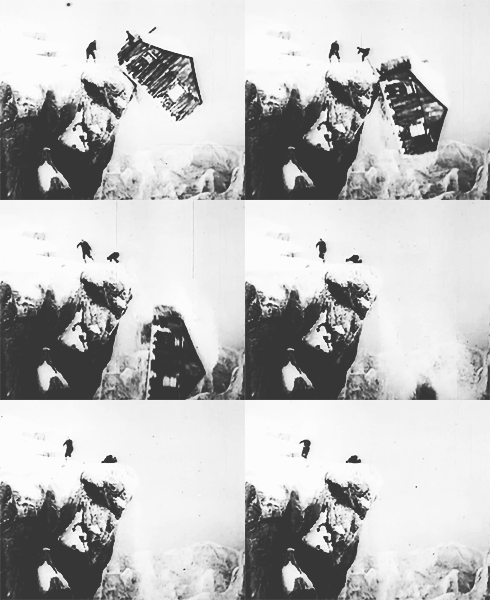
Also, you can immediately recognize a serious mastery of storytelling that Chaplin brings both as a director and as an actor. The scene where the house is tipping over the edge of a cliff is by far my favorite, both because of how long it takes Chaplin and the prospector to figure it out, and also because of the cutting between the house tipping side to side and the characters running around the house to fix it.
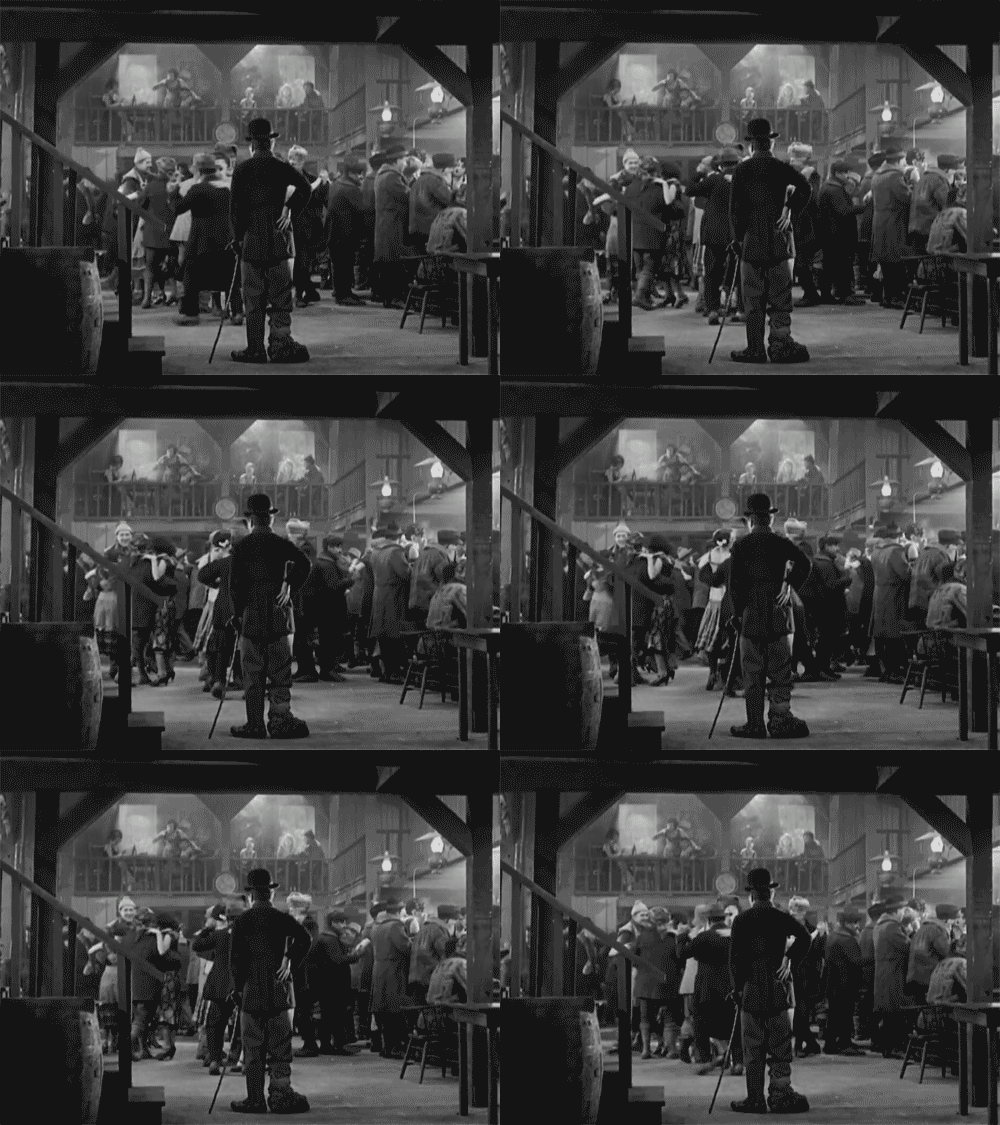
Finally, as my friend pointed out, some of the shots are just beautiful. It’s always great to see an old film and be like “this story really speaks to me, I feel as if I’m there.” The dance hall where most of the town socializes is our modern… okay so we don’t socialize in person anymore, but maybe a playground if we were still kids in the 90s. And every shot conveys that idea of Chaplin’s character being an outsider, and yet somehow I’m still laughing because everything he does it so comedic and awkward.
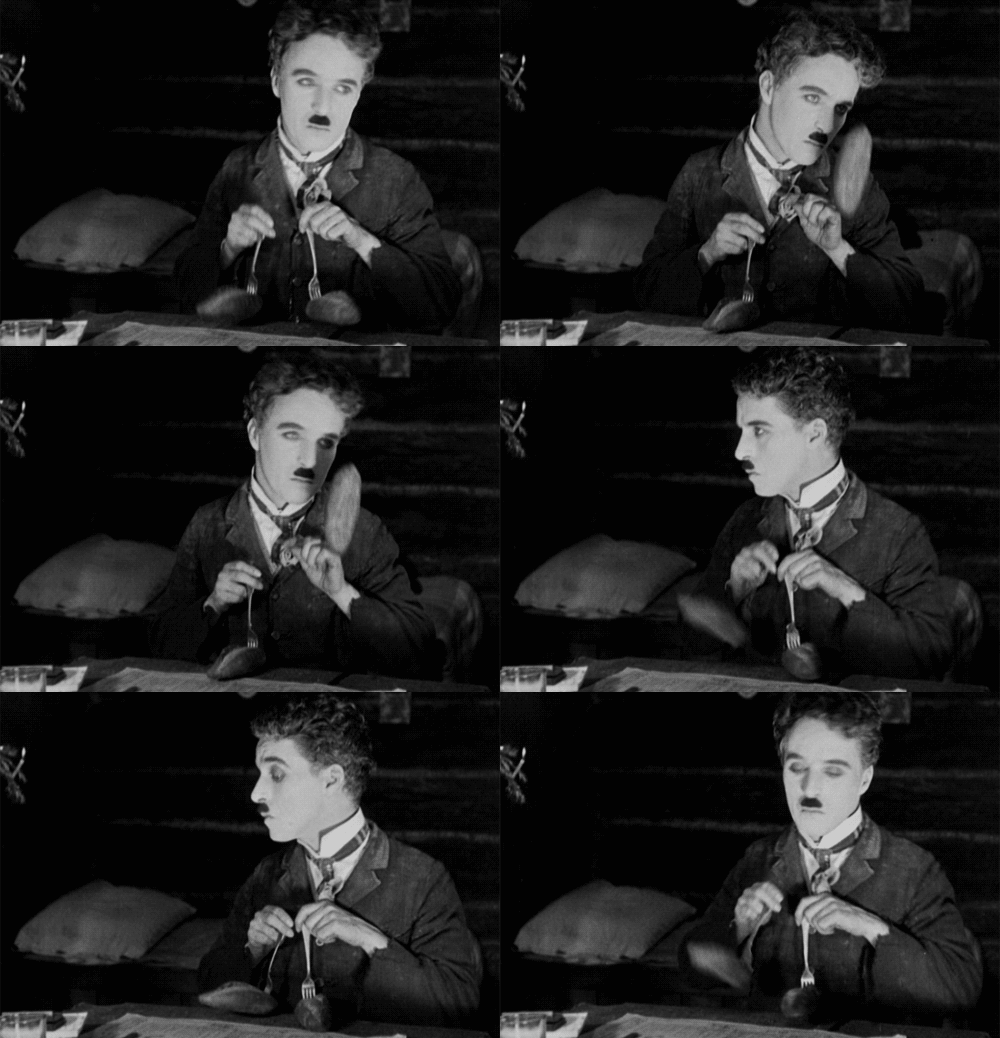
Even when looking sad, Chaplin still manages to look ridiculous. Here he is wearing a sack for a shoe because he ate his right shoe during the blizzard. I can honestly say that during most of the film my friend and I looked like this.
Overall, the film definitely earns its spot in the Top 250, and I wish the Oscars had been around in 1925 to give this film the credit it deserves!