It occurred to me after reviewing the Charlie Chaplin classic “The Gold Rush” that I should probably start reviewing more recent/popular films so that I can reach a bigger audience. So in the name of writing more for 2013, I’m going to try to review any movie I watch entirely (without commercial breaks, because those ruin everything), that I feel capable of discussing on here.

The disaster film has been around forever, because as long as film has existed, artists have imagined the end of humanity. However, the 1970s are considered the golden age of the disaster film, when people took a real interest in seeing huge blockbuster films about the end of the world. The first two to be wildly successful in the genre were “Airport” and “The Poseidon Adventure” (a personal favorite of mine). I have two theories as to why the 70s were such a great period for disaster films. First, the Cold War left many terrified about the collapse of Western culture, and cinema took advantage of that sort of pandemonium by portraying the threat to modern civilization in a less direct way. Second, technology was improving, allowing for better special effects that made the films more realistic. The genre became so popular that the 1980 film “Airplane!” is actually a parody of the genre. It’s like the 1980 version of the 2008 “Disaster Movie”… except “Airplane!” is actually funny.

You heard me Sarah Jessica Parker. Anyway. The genre didn’t have a revival until the 1996 “Independence Day” (also directed by Roland Emmerich by the way). What really defined the comeback of the genre were the massive budgets and insane special effects, now made possible with recent CGI technology. Studios were spending over a hundred million dollars to make films like 1997’s “Titanic,” and 1998’s “Deep Impact” (another personal favorite). People were going to see films about the end of the world again, and studios popped them out like the Duggers pop out kids.
The 2004 film “The Day After Tomorrow” is an awesome film to watch, because it does something that studio films so often fail at - having meaningful plots and depth in characters. “2012” (also strangely enough done by Roland Emmerich) failed critically, and I think it was because of the uninteresting character-related plots. Usually the special effects are just too massive for the film to get into any personal stories, and an audience gets lost in a plot they can’t relate to. This is what “Titanic” did so well, it took a story of massive scale, and provided relatable characters that put the disaster into perspective. I think that “The Day After Tomorrow” actually succeeds at this, and that’s why I can still watch it today and love it.
The story centers around one family, the one the audience has to immediately connect with or the film fails. There’s Jack Hall (Dennis Quaid), the climatologist who is one of the first to discover the impending storm, and basically fails to warn the government about it. Sam (Jake Gyllenhaal), his son, who is at a Scholastic Decathlon in NYC because he has a crush on a girl, Laura (Emmy Rossum). Finally, there’s Sam’s mother, Lucy, a doctor in D.C. who is caring for a boy with cancer. When Jack discovers that the northern part of the United States is doomed, he decides to travel from D.C. to NYC to find his son, and brings along his team (Frank and Jason).
One problem (and maybe the only one) that I have with the film is that it attempts an almost “Titanic” sized plot without enough time to have it all work. The movie follows Jack’s journey to NYC, Sam’s struggle to survive, and Lucy’s experience with the boy in the hospital that she cares for (probably the most endearing in the film). But it also repeatedly returns to the story of three astronauts at the international space station (our only information is that they were about to come home, but their landing was postponed because of the storm), and three scientists studying the climate change in Scotland, who eventually get trapped because of the storm and ultimately die.

I know Joseph, it’s a lot. Maybe too much, in my opinion. Aside from character development, the film has spectacular special effects (not enough for even an Oscar nomination though, surprisingly) and a great “save the environment” subplot that you gotta just love. This film actually comes a whole two years before “An Inconvenient Truth” took the country by storm (sorry I had to), warning us of the negative environmental effects of our actions. This “we have to change” undertone is present in all parts of the film, and I love it because it’s the most honest way to make a disaster film work. The film also touches on the “we will survive” thread that permeates many disaster films, especially ones like “War of the Worlds” and “Deep Impact.” It gives hope during a time of extreme distress, especially because climate change is a very real thing in our world (Hurricane Sandy, Snowpocalypse 2010) and I liked that it had more of an emphasis on “our current way of life will no longer work” than “good thing we survived” like “2012” did.
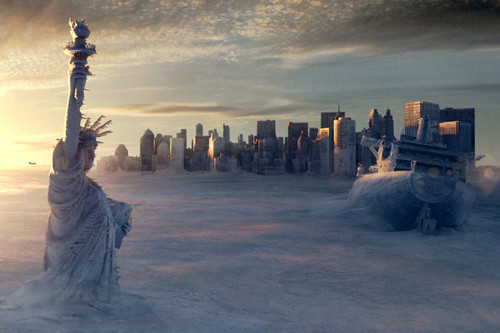
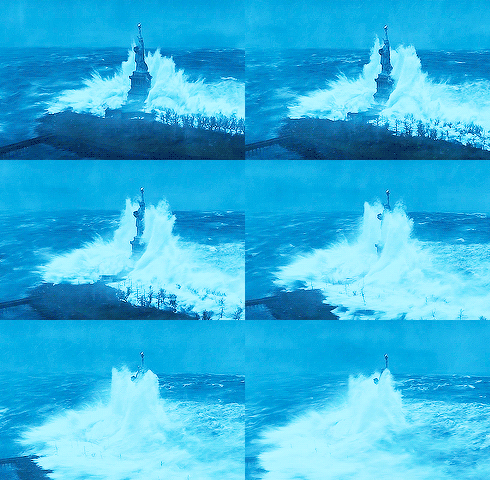
While the science of the film isn’t exactly sound, it actually comes up with a very imaginative way of adding even more danger to the film. The farfetched idea of the “instant freezing” is the one I remember most from the film. And the haunting image of the American flag freezing still sticks with me. As a member of the disaster genre, the film puts an emphasis on “the threat to Western culture” and does so using iconography very relatable to an audience. I mean, have you ever seen a disaster film without some reference to the Statue of Liberty? Probably not, because it’s the pinnacle of modern American civilization. It’s literally the gateway to our society. And disaster films love to threaten it. Also, the American flag freezing is a perfect way to show how this storm is literally a “halt” to our progress as a society. That maybe we need to take a step back and see if what we’re doing is okay for our planet. It’s beautiful and corny and I love it.
But even more importantly, this image of the sun just behind the statue, and a still-standing city of Manhattan in view is one of the images the film leaves you with. A great way to end a haunting film about the end of times, with hope and the idea that civilization will continue to survive.
I’m ranting now, so I’ll end with this. “The Day After Tomorrow” is a fantastic film to watch, especially now that all of this “Mayan Apocalypse” stuff has died down (although it would have been epic to watch on December 19th, 2012). In today’s world, where cinema is divided into the Oscar-winning independent films of the winter and the tentpole studio films of the summer, I am glad to say that I actually enjoyed this one by 20th Century Fox. Also, the romance between Jake Gyllenhaal and Emmy Rossum is extra fun, knowing that within just a year, Jake would move on to Heath Ledger in “Brokeback Mountain” and Emmy Rossum would move on to Gerard Butler in “The Phantom of the Opera.”